Driving through the lush tea hills and spice plantations of Idukki—whether along the Munnar–Kumily Highway (NH 183), the winding slopes of Kattappana, or the steep descents toward Cumbum—is an exhilarating experience. But when an unexpected mechanical failure strikes—such as an overheated engine, clutch failure, flat tire, or sudden power loss—the winding mountain roads can quickly become dangerous.
Unlike flat urban highways with wide paved shoulders, high-range mountain roads often have narrow lanes, deep drainage gullies, blind hairpin curves, and limited mobile network coverage in valley pockets. Knowing the exact sequence of actions to take can protect you, your family, and other oncoming motorists.
Step 1: Steer to Safety Immediately
The moment you sense power loss, sputtering, or brake fade, do not brake abruptly in the middle of a blind corner. If the vehicle still has momentum, carefully coast as far to the left road shoulder as possible, away from the active traffic flow.
If you are ascending a steep incline, try to pull into a viewpoint turnout, estate gate entrance, or straight road section where approaching drivers from both directions can clearly see your vehicle from at least 100 meters away.
Step 2: Activate Hazard Blinkers & Warning Triangle
Switch on your vehicle's four-way hazard flashers immediately. This alerts oncoming traffic that your vehicle is stationary.
Critical Mountain Rule: Place Warning Triangle Early
Never place your red reflective warning triangle right next to the car bumper! On winding mountain roads, place it 40 to 50 meters behind your vehicle, well before the curve begins, so descending drivers have ample warning to slow down.
Step 3: Secure the Vehicle Against Rollaway
One of the biggest hazards on steep mountain roads is vehicle rollaway. High-range inclines put enormous pressure on mechanical parking brakes.
- Firmly pull up the handbrake to its maximum engagement point.
- In a manual transmission car, leave the vehicle in 1st gear if facing uphill, or Reverse gear if facing downhill.
- In an automatic car, shift into Park (P).
- Turn the front wheels toward the hillside embankment (curb) so that if the car moves, it rolls into the slope rather than into oncoming traffic or down the ravine.
- Place a heavy stone or wheel chock securely behind the rear tires for added physical security.
Step 4: Evacuate All Passengers to the Safe Hillside
Never allow family members or passengers to sit inside a stalled car parked on a narrow road or standing on the traffic-facing side of the road. On mountain passes, descending heavy trucks or speeding tourist buses might round a blind bend and clip a stationary vehicle.
Move all passengers out through the hillside doors, step over roadside crash barriers, and wait safely on elevated ground or the upper tea garden embankment away from the roadway.
Step 5: What NOT to Do During a Breakdown
- DO NOT open a hot radiator cap: If the temperature gauge is in the red or steam is venting, the coolant is pressurized above boiling point. Opening the cap will cause severe scalding burns. Wait at least 30 minutes for the engine to cool down naturally.
- DO NOT coast in neutral downhill: If the engine stalls on a descent, your power steering and power brake booster will lose vacuum assist after one or two pedal presses. Always remain in low gear.
- DO NOT attempt to push the car uphill: Pushing a heavy car on a steep mountain gradient is extremely dangerous and risks crushing injuries.
Step 6: Contact Jo Recovery Van Service (24×7 Dispatch)
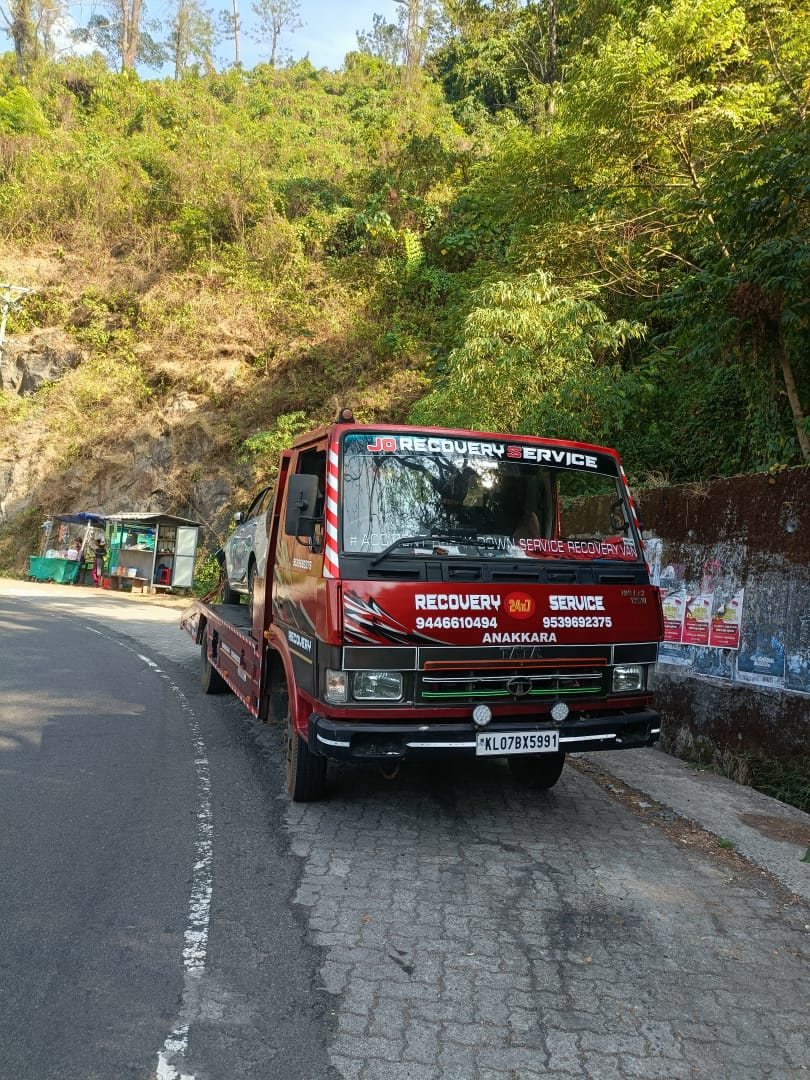
Once everyone is safely situated, contact our emergency recovery dispatch desk. Located at Kalladathur, Anakkara on the Munnar–Kumily Highway, our team can reach you within 15 to 30 minutes across most of Idukki.
Need Roadside Recovery Right Now?
Direct telephone hotline active 24/7 across Anakkara, Kumily, Vandiperiyar, Kattappana, and Nedumkandam.
Step 7: How to Accurately Share Your Location
Because street addresses do not exist along many rural stretches of the high ranges, providing landmarks helps our recovery driver locate you rapidly.
- Look for official highway kilometer stones (e.g., "NH 183 Km 142").
- Check for named cardamom or tea estate divisions (e.g., Wallardie, Kallar, Chelimada).
- Open WhatsApp or Google Maps on your phone, tap the paperclip/plus icon, select "Location", and choose "Share Live Location" or "Send Your Current Location" directly to our WhatsApp number: +91 94466 10494.